How to Make a Piston in Minecraft and What It Can Push
Three planks, 4 cobblestone, 1 iron ingot and 1 redstone make a piston. How to make a piston, its 12-block push limit, and blocks it can't move.
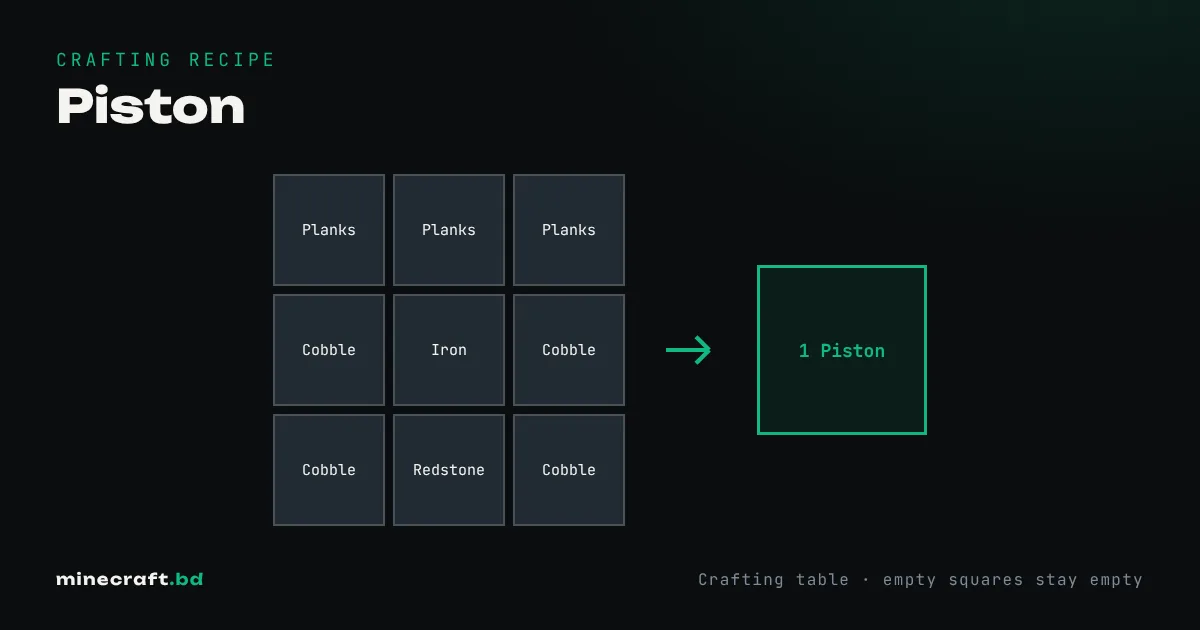
A piston takes 3 planks, 4 cobblestone, 1 iron ingot and 1 redstone dust. On a crafting table, put the planks across the top row. In the middle row, put cobblestone on the left, the iron ingot in the center and cobblestone on the right. In the bottom row, cobblestone, redstone dust, cobblestone. You get one piston.
Any planks work. Cobbled deepslate and blackstone can stand in for the cobblestone.
What a piston does
Give a piston a redstone signal and its head shoots out one block, pushing whatever is in front of it. Take the signal away and the head retracts, leaving the block where it was pushed. It faces toward you when you place it, so look in the direction you want it to push from.
A piston pushes up to 12 blocks in a row. If there are 13, or if one of the blocks is immovable, it won’t extend at all.
Blocks pistons can’t move
- Immovable: obsidian, crying obsidian, bedrock, end portal frames, reinforced deepslate, and extended pistons.
- Containers and block entities (Java): chests, furnaces, hoppers, barrels, beacons, enchanting tables and similar blocks don’t move in Java.
- Break when pushed: pumpkins, melons, cobwebs, torches, flowers and most plants pop off as items. That’s the basis of most automatic melon and pumpkin farms.
Bedrock has different rules for block entities and different timing. A design that works in Java can misbehave in Bedrock, so use guides made for your edition.
Piston or sticky piston?
A normal piston pushes and lets go. A sticky piston pushes and pulls the block back. Rule of thumb:
- Normal piston: crop harvesters, pushing items or mobs, block breakers, one-way pushers, flush walls that move once.
- Sticky piston: doors, hidden entrances, anything that needs to open and close.
You need a normal piston to make a sticky one anyway, so build a few.
First builds
The classic first build is a 2x2 piston door: four sticky pistons hiding a doorway, opened by a lever or pressure plate. Our piston doors guide walks through it step by step, then moves on to hidden entrances.
Other easy ones:
- Sugar cane or bamboo farm: an observer watching the crop fires a piston that breaks the top section.
- Moving wall or bridge: a row of pistons extends blocks over a gap.
- Power source on the move: a block of redstone pushed by a piston powers whatever it lands next to, which is how many flying machines work.
The iron ingot is the only part that can slow you down early. If you need a lot of pistons, see how to find iron. For signal basics before you wire anything, start with redstone basics.
Common questions
How many blocks can a piston push?
Up to 12 in a line, including blocks attached by slime or honey. A 13th block, or any immovable block in the way, stops it from extending.
What is the difference between a piston and a sticky piston?
A normal piston only pushes. A sticky piston, made by adding a slimeball, also pulls the block back when it retracts.
Can pistons push chests?
Not in Java Edition, where chests, furnaces and other containers are immovable. Bedrock handles block entities differently, so test it in your world before relying on it.
Sources & verification
Facts on this page are checked against these references and in-game behavior for the stated edition(s). how we verify.
Keep reading