How to Build an Automatic Farm in Minecraft: Observer Builds
Most automatic crop farms use an observer and a piston. Layouts for sugar cane, pumpkins, melons, bamboo and kelp, how villager farms differ, and loading.
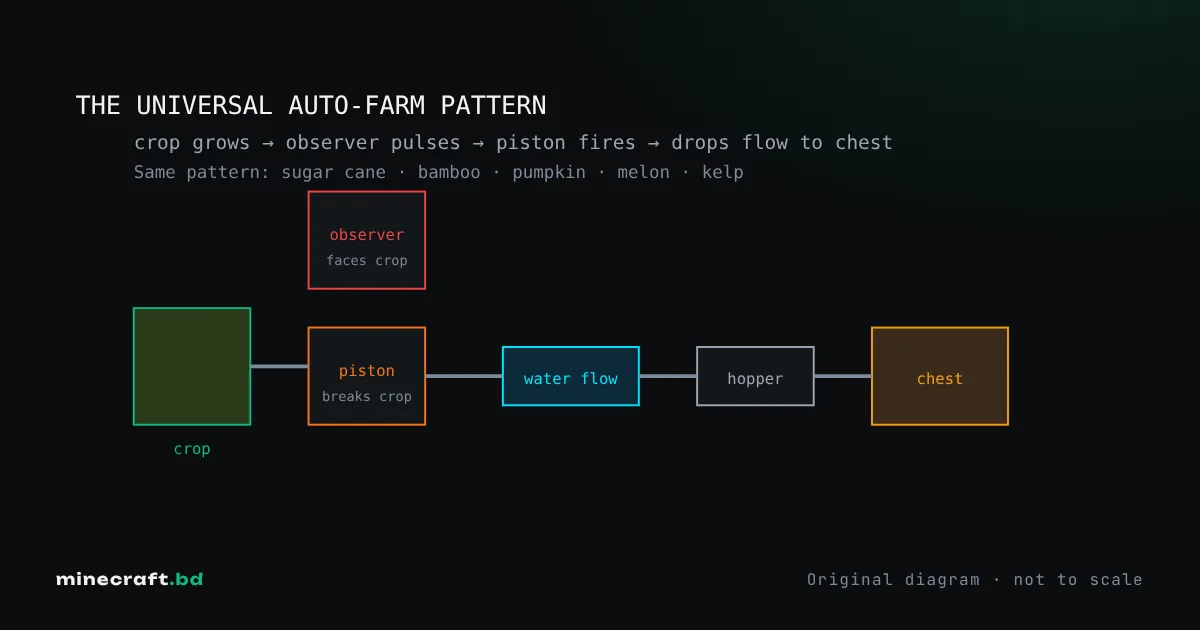
Most automatic crop farms run on one idea: an observer watches the spot where a crop grows, sends a redstone pulse the moment something appears there, and a piston next to it breaks the crop. The drops then fall into hoppers or ride a water stream to a chest. Learn this once and you can automate sugar cane, pumpkins, melons, bamboo, cactus and kelp with small variations.
If you haven’t set up a basic hand-planted farm yet, start with how to start a farm. This page is the next step.
The observer pattern
An observer has a face that looks at one block. When that block changes, the observer gives out a short redstone pulse from its back. Put a piston where that pulse reaches, pointed at the crop, and the piston fires every time the crop grows.
That’s the whole trick. Each farm is just a question of where to point the observer and where to put the piston. If you’ve never wired a pulse before, redstone basics explains how signals travel.
Sugar cane
Sugar cane grows on dirt, sand or grass next to water, up to three blocks tall.
- Plant a row of cane with water beside it.
- At the height of the second cane block, put a piston behind each plant, facing it.
- On top of each piston, put an observer facing the cane, so it watches the space where the third cane block will appear.
- Behind the pistons, lay a row of solid blocks, and run redstone dust along the top of them. Each observer’s back now points into that dust. When an observer fires, the dust powers the block under it, and that block powers the piston in front of it.
When the cane reaches full height, the observer fires, the piston pushes out the middle block, the top block drops with it, and the base stays to grow again. Run a line of hoppers along the front, or a water stream feeding into one hopper, to catch the cane. A long row of these gives you all the paper you’ll need for books and librarian trades.
Pumpkins and melons
Stems need farmland, and the fruit appears on a block next to the stem. Put an observer above each fruit spot, looking down at it, and a piston behind the fruit spot. When a pumpkin or melon appears, the piston breaks it. Leave only one free dirt block beside each stem so the fruit always grows where the observer is looking. Melons drop slices; pumpkins drop whole.
Bamboo and cactus
Bamboo grows fast and tall. Put an observer watching the second or third block of bamboo and pistons along that level; when the observer sees growth, the whole row of pistons fires. Bamboo is mostly useful as furnace fuel and for scaffolding.
Cactus needs no redstone at all. Cactus breaks when a block is placed next to it, so put a fence or any block diagonally above the plant, and the new growth pops off on its own. Drops fall onto hoppers below or into a water stream.
Kelp
Kelp grows underwater in a column. Place an observer at the level of the second kelp block and pistons along that row. It’s quick to build, and kelp dries in a smoker into dried kelp, which crafts into dried kelp blocks, a good furnace fuel. A kelp farm feeding a row of smokers that burn the blocks they make is a classic closed loop.
Villager-powered farms
Wheat, carrots, potatoes and beetroots can’t be harvested cleanly with pistons, because they need replanting. Farmer villagers solve this: a farmer harvests and replants these crops on farmland around it. When it has more food than it needs, it throws some to nearby villagers, and hoppers placed under where the food lands catch the surplus. Designs differ a lot between Java and Bedrock, so follow one tested on your edition.
Keep farms loaded
Crops only grow in chunks that are loaded and inside your simulation distance. A farm 500 blocks away from your base will do nothing while you’re home. Build them close by, and if you want a farm to keep running while you’re away, be in range of it.
For animals instead of crops, the same “let it grow, then collect” logic drives an automatic chicken farm.
Common questions
What's the easiest first automatic farm?
Sugar cane. It needs no replanting, and each module is just a cane plant, an observer, a piston and some way to collect the drops. It also feeds paper for books and trading.
Do crops grow when I'm far away?
No. Crops only grow in chunks within your simulation distance (Java's always-loaded spawn chunks were removed in 1.21.9). Build farms near where you spend time.
Why does my observer farm break the base of the sugar cane?
The piston is at the wrong height. It must sit level with the second block of cane, so it pushes that block and leaves the bottom one to regrow.
Sources & verification
Facts on this page are checked against these references and in-game behavior for the stated edition(s). how we verify.
Keep reading