Panda in Minecraft: 7 Personalities and the Rare Brown Panda
Each panda has one of seven personalities set by two genes. Where to find pandas in jungles, breeding them with bamboo, and why brown pandas are rare.
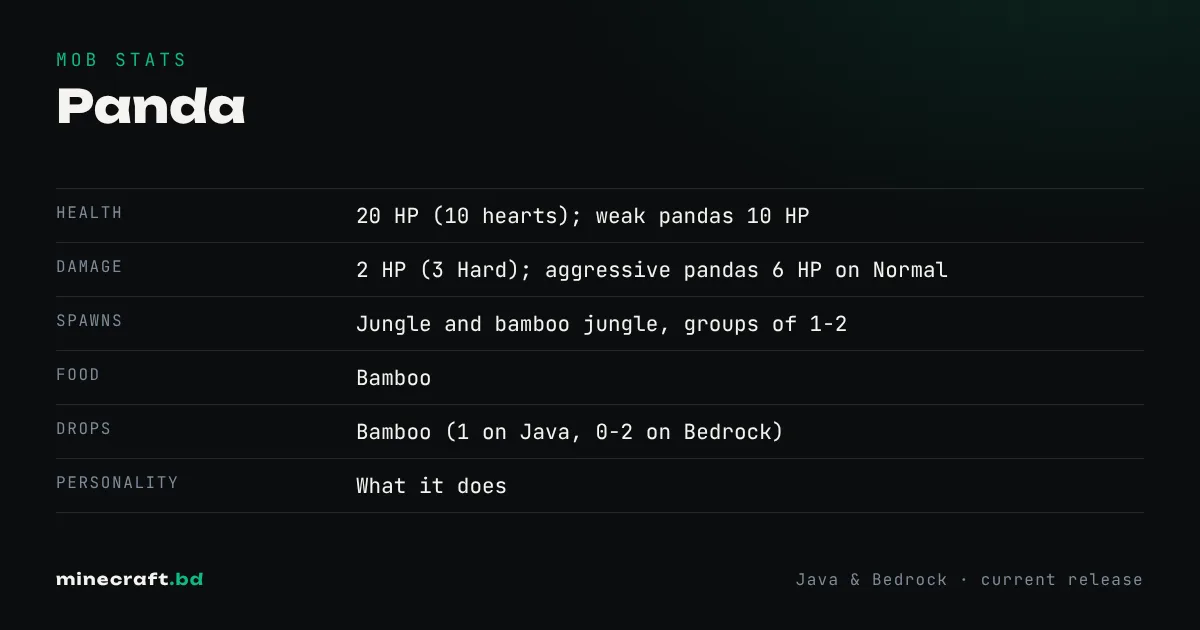
Pandas are rare jungle animals that spend their day eating bamboo, rolling around and sneezing. Each one has one of seven personalities (normal, lazy, worried, playful, aggressive, weak or brown), decided by a pair of genes it passes on to its babies. They’re neutral: only the aggressive ones fight back.
| Stat | Value |
|---|---|
| Health | 20 HP (10 hearts); weak pandas 10 HP |
| Damage | 2 HP (3 Hard); aggressive pandas 6 HP on Normal |
| Spawns | Jungle and bamboo jungle, groups of 1-2 |
| Food | Bamboo |
| Drops | Bamboo (1 on Java, 0-2 on Bedrock) |
Finding pandas
Look in a jungle, especially a bamboo jungle, where the thick bamboo cover is easy to spot from a hill. Spawns are rare and come in ones and twos, so expect to search. Bedrock also spawns them in sparse jungle. Bring bamboo with you: hold it and pandas follow you, which is the only practical way to move one.
The seven personalities
| Personality | What it does |
|---|---|
| Normal | Nothing special |
| Lazy | Lies on its back, slow to follow |
| Worried | Hides its face during thunderstorms, avoids monsters |
| Playful | Rolls over and jumps around |
| Aggressive | Fights back and hits hard |
| Weak | Half health, sneezes more often |
| Brown | Brown and white coat |
How genes work
Each panda carries two genes: a main gene and a hidden gene. Normal, lazy, worried, playful and aggressive are dominant; weak and brown are recessive. A dominant main gene always shows. A recessive one only shows if the hidden gene matches. So a brown panda has two brown genes, and a normal-looking panda can quietly carry a brown gene.
When two pandas breed, the baby takes one random gene from each parent, with a small (1 in 32) mutation chance per gene. If you want brown pandas, breed a brown with anything, then breed the babies with each other or back with the brown parent. Natural spawns are about 1.6% brown, so breeding is far faster than searching.
Breeding
Pandas only go into love mode when bamboo is growing close by. On Java, one bamboo plant within a 7x7x3 area is enough. On Bedrock, each panda needs at least eight bamboo plants within five blocks, so plant a ring of bamboo around the pen first. Then feed both adults bamboo.
Bamboo also gives you scaffolding, so a bamboo patch next to a panda pen pulls double duty.
Sneezes and slimeballs
Baby pandas sometimes sneeze, and each sneeze has a small chance of dropping a slimeball. Weak babies sneeze far more often. It’s a real slimeball source, but a slow one; a slime chunk farm beats it by a mile. A sneeze also makes nearby adults jump, which is mostly just funny.
Edition differences
- Aggressive pandas are more dangerous on Java and defend nearby pandas there.
- Worried pandas avoid monsters on Java but avoid every non-panda mob on Bedrock.
- Java pandas always drop one bamboo; Bedrock drops 0-2 and Looting helps.
For other jungle wildlife such as the parrot, see the mobs hub.
Common questions
How do you get a brown panda?
A brown panda needs two brown genes. Spawn odds are about 1.6%, so most players breed for it: pair pandas that carry the hidden brown gene and keep the brown babies.
How do you breed pandas?
Feed two adults bamboo while bamboo is growing nearby. Java needs at least one bamboo plant within a few blocks; Bedrock needs eight within five blocks of each panda.
Do pandas attack you?
Only aggressive pandas, and only if you hit them or a nearby panda. Every other personality just runs or sits there.
Sources & verification
Facts on this page are checked against these references and in-game behavior for the stated edition(s). how we verify.
Keep reading