Husk in Minecraft: The Desert Zombie That Doesn't Burn
Husks are desert zombies with 20 health that survive daylight and give you Hunger with each hit. Where husks spawn, what they drop, and how they convert.
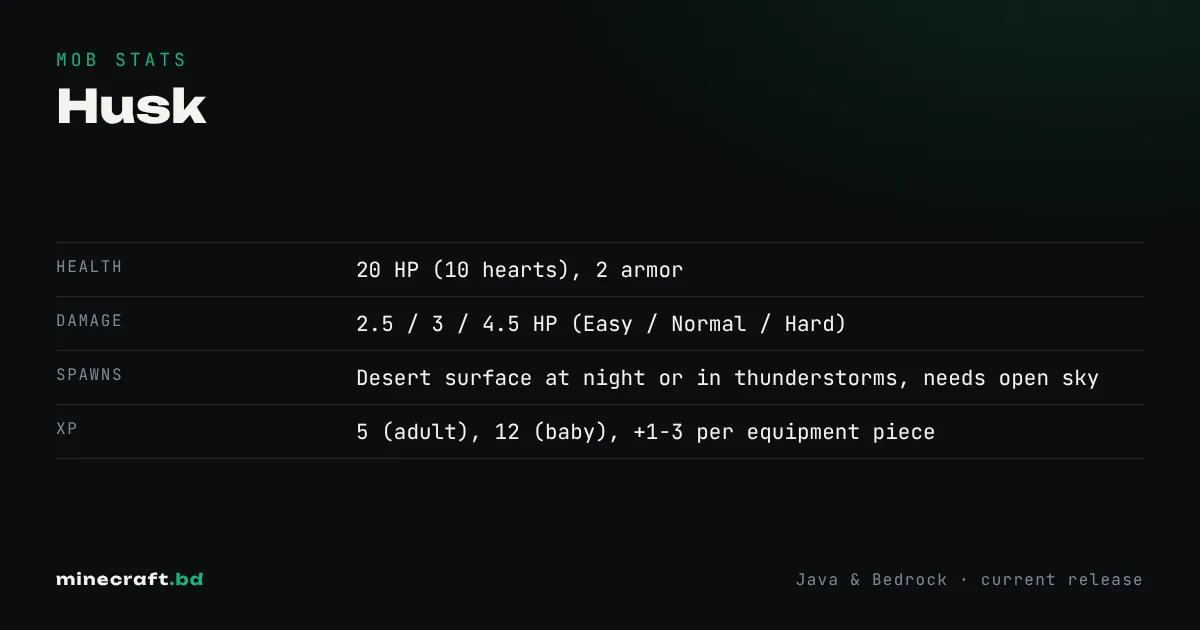
A husk is the desert version of the zombie: same 20 health, same shuffle, but it doesn’t catch fire in daylight, and every unarmed hit gives you the Hunger effect. If you’re crossing a desert after sunrise and still being chased, it’s a husk.
| Stat | Value |
|---|---|
| Health | 20 HP (10 hearts), 2 armor |
| Damage | 2.5 / 3 / 4.5 HP (Easy / Normal / Hard) |
| Spawns | Desert surface at night or in thunderstorms, needs open sky |
| XP | 5 (adult), 12 (baby), +1-3 per equipment piece |
Where husks come from
Husks replace most zombies that spawn on the open surface of a desert: roughly 80% on Java and 70% on Bedrock. They need full sky light, so a husk you meet underground in a desert has usually wandered down from above. About 5% spawn as babies, which are fast, small and annoying to hit.
You’ll also run into them in trial chambers, where a trial spawner has a one-in-three chance of using husks as its melee mob, whatever biome the chamber is under.
The Hunger problem
Each unarmed hit from a husk applies Hunger, and the duration scales with regional difficulty (7 seconds multiplied by the local difficulty value). On Hard in a world you’ve played in for a while, a few hits can drain a good chunk of your food bar. A husk holding a sword or shovel doesn’t apply Hunger, which is one of the few times an armed mob is less of a nuisance.
What this means in practice:
- Carry more food than usual on desert trips. Bread or cooked beef from a farm keeps you topped up.
- A shield blocks the hit and the Hunger with it.
- Fight at range if you can. Husks are slow, and a bow takes them apart before they close the gap.
Otherwise they fight exactly like zombies. Smite works on them, they break wooden doors on Hard, and baby husks can spawn as chicken jockeys on Java.
Drops
Husks share the zombie loot table: 0-2 rotten flesh, plus a rare (about 0.8%) chance of an iron ingot, carrot or potato when a player or tamed wolf gets the kill. Equipment they spawned with has an 8.5% drop chance on Java. Rotten flesh isn’t much, but it trades to cleric villagers and feeds tamed wolves.
Water and conversion
Husks avoid water, but if one stays fully submerged for 30 seconds it starts converting and becomes a regular zombie 15 seconds later. Leave that zombie underwater and it eventually turns into a drowned. Drowned made by conversion never carry tridents, though, so trident hunters still need naturally spawned drowned.
Java and Bedrock differences
- Java husks can call reinforcements on Hard and pick up items they walk over. Bedrock husks actively walk toward dropped items.
- On Bedrock, baby husks can ride other mobs (15% of babies); on Java they only ride chickens.
- Armor a husk wears doesn’t lose durability on Java, but wears down on Bedrock.
For every other undead and desert threat, the mobs hub lists them all.
Common questions
Do husks burn in the sun?
No. Husks are immune to sunlight, so unlike regular zombies they keep chasing you through the whole desert day.
Can a husk turn into a drowned?
Not directly. A husk that stays underwater for about 45 seconds turns into a normal zombie first, and that zombie becomes a drowned if you leave it submerged.
What does a husk drop?
Usually 0 to 2 rotten flesh. Rarely it drops an iron ingot, carrot or potato, and any armor or weapon it spawned with has a small chance to drop.
Sources & verification
Facts on this page are checked against these references and in-game behavior for the stated edition(s). how we verify.
Keep reading