How to Make a Redstone Comparator: Both Modes Explained
Three redstone torches, 1 nether quartz and 3 stone make a comparator. How to make a redstone comparator, use both modes, and read chests.
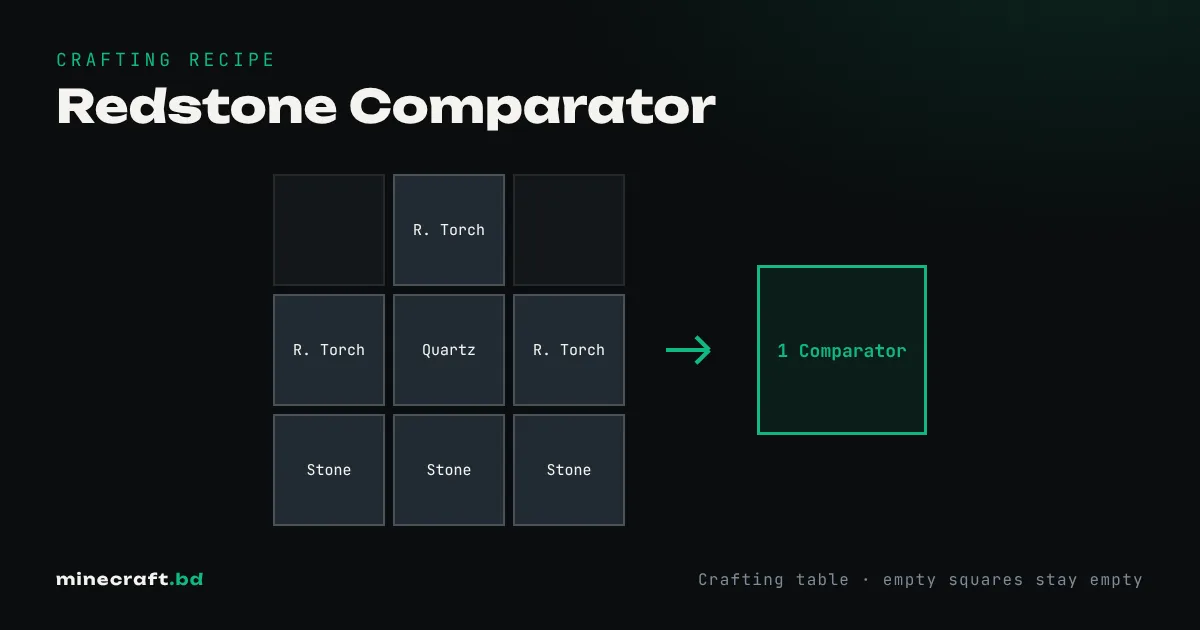
A redstone comparator needs 3 redstone torches, 1 nether quartz and 3 stone. On a crafting table, place a redstone torch in the top-middle slot, then torch, quartz, torch across the middle row, and 3 stone across the bottom row. You get one comparator. (Bedrock 26.50 shortened the in-game name to just “Comparator”; Java still calls it a redstone comparator.)
The materials
- Stone, not cobblestone and not smooth stone. Smelt cobblestone once in a furnace and you get stone. If the recipe won’t appear, this is nearly always why.
- Nether quartz comes from nether quartz ore, which is common all over the Nether. Any pickaxe mines it.
- Redstone torches are a redstone dust on top of a stick.
What a comparator does
A comparator has a back input, two side inputs and a front output. It has two modes, switched by using it:
- Compare mode (front torch off): if the back signal is at least as strong as the stronger side signal, the output equals the back signal. Otherwise it outputs nothing.
- Subtract mode (front torch on): the output is the back signal minus the stronger side signal.
Unlike a repeater, a comparator doesn’t boost the signal to 15. It passes on the strength it gets, which is what makes it useful for analog circuits.
Reading containers
This is the main reason most players craft one. Put a comparator facing away from a chest, hopper, barrel, furnace or brewing stand and it outputs a signal from 0 to 15 depending on how full the container is. An empty chest gives 0, a full one gives 15, and anything with at least one item gives at least 1.
That turns into:
- Item sorters, where a comparator notices when a filter hopper gets an extra item.
- “Storage full” lights that warn you before a farm’s chest overflows.
- Furnace arrays that know when a batch is done.
It can read through one solid block, so you can hide the comparator behind a wall.
Other blocks it reads
- Cake: 2 for each slice left, so a full cake gives 14.
- Item frame: 1 to 8, depending on how many times you’ve rotated the item.
- Jukebox: a different strength for each music disc.
- Composter, cauldron, beehive, lectern: fill level, honey level or page number.
- Respawn anchor and end portal frame: charge level, or whether an eye is in place.
Item frames are a favorite for combination locks. Rotate the item to the right position and the comparator unlocks a door.
The comparator is the hardest part to understand in basic redstone. Build one container reader first, then read redstone basics to see how it fits with dust, torches and the observer.
Common questions
Can you use cobblestone or smooth stone for a comparator?
No. It needs plain stone, which you get by smelting cobblestone once. Smelting stone again makes smooth stone, which doesn't work in this recipe.
What is the difference between a comparator and a repeater?
A repeater boosts a signal back to 15 and adds delay. A comparator keeps the signal's strength, compares it with a side input, and can read how full a container is.
How do you switch a comparator to subtract mode?
Use it (right-click on PC). The small front torch lights up when it's in subtract mode.
Sources & verification
Facts on this page are checked against these references and in-game behavior for the stated edition(s). how we verify.
Keep reading