How to Cure a Zombie Villager for Cheap Trades
Throw a splash potion of Weakness at a zombie villager, then feed it a golden apple. Keep it safe for 3 to 5 minutes while it converts, then trade cheap.
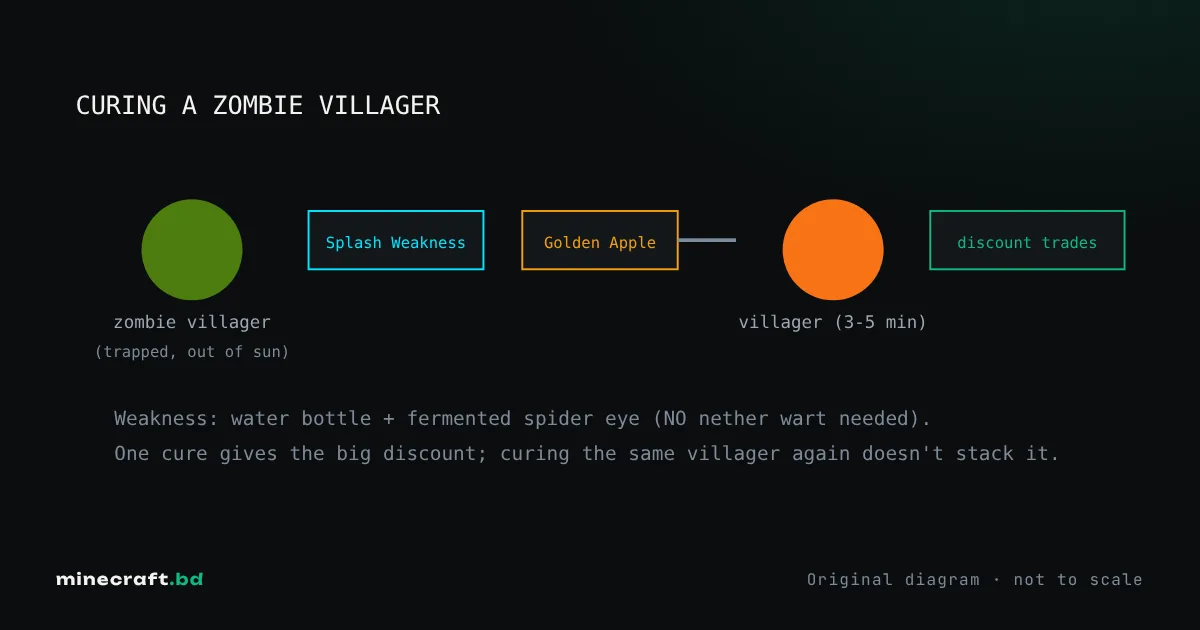
To cure a zombie villager, hit it with a splash potion of Weakness, then use a golden apple on it while the Weakness is still active. It starts to shake and gives off red particles, and 3 to 5 minutes later it turns back into a villager. If it had a job before it was zombified, it keeps that job, and it gives you a big permanent discount on its trades.
What you need to cure a zombie villager
- A splash potion of Weakness. Brew it from a water bottle plus a fermented spider eye. It’s the one useful potion that skips nether wart, so you can make it as soon as you have a brewing stand. Add gunpowder to make it a splash potion. The brewing guide covers the setup, and Potion of Weakness has the details.
- A golden apple. One apple surrounded by 8 gold ingots. It must be a plain golden apple, not an enchanted one.
- Somewhere safe for it. A zombie villager burns in daylight and can despawn if you walk away, so trap it first.
Curing a zombie villager step by step
- Trap it. Lure it into a 1×1 hole with a roof, a small cell, or a boat under shade. Zombie villagers chase you just like zombies, so they’re easy to lead.
- Throw the potion. Gray swirls around the zombie villager mean the Weakness took.
- Feed it the golden apple. Hold the apple and use it on the zombie villager. It starts shaking and gives off red particles. If nothing happens, the Weakness missed.
- Wait. 3 to 5 minutes. Keep it in the shade and don’t wander too far, or on Bedrock the timer pauses.
- Trade. When it becomes a villager again, check its trades. The prices should be noticeably lower.
Beds and iron bars in the area around it speed the cure up a little, but not enough to bother building for one cure.
The discount
This is the reason players cure villagers on purpose. The villager you cured gives you, and only you, a large discount that never wears off. A librarian charging 30-odd emeralds for a book can drop to a handful, and cheap trades often fall to a single emerald.
Some things to know:
- Cure it once. Curing the same villager a second time doesn’t add more discount.
- Nearby villagers get a smaller share. Villagers that witness the cure, through gossip on Java or proximity on Bedrock, give you a smaller discount too.
- Get the right job first. The discount only applies to a villager that had a profession before it was zombified. If you’re zombifying villagers on purpose, set up the job and trade with it once so it locks before you let a zombie at it.
That last point is the “zombify and cure” method for a trading hall. Let a zombie attack a locked-in librarian (on Hard difficulty the villager always turns into a zombie villager; on Normal it’s a 50% chance), then cure it. Switch the difficulty to Hard while you do it if you can, so you don’t lose a good librarian.
Where to find zombie villagers
Some zombies that spawn at night are zombie villagers; you’ll spot the villager nose and robe. Abandoned villages (all zombie villagers) and igloo basements also have them. Or make one yourself using the method above. If you’re working out which professions to build a trading hall around, see all villager jobs.
Common questions
How long does curing take?
Between 3 and 5 minutes. Iron bars and beds within a few blocks speed it up a little, but not enough to matter much.
Do discounts stack if I cure the same villager again?
No. A villager gives its big discount the first time you cure it. Curing it again does not add more.
Can I use an enchanted golden apple?
No. The cure needs a regular golden apple. An enchanted golden apple will not start it.
Why did my zombie villager not cure?
It probably did not have Weakness when you fed it the apple, or the Weakness wore off first. Hit it with the splash potion, check for the swirling particles, then use the apple right away.
Sources & verification
Facts on this page are checked against these references and in-game behavior for the stated edition(s). how we verify.
Keep reading