How to Get Clay in Minecraft and Make It Renewable
Clay sits in shallow rivers, lakes and lush caves; each block drops 4 clay balls. How to get clay in Minecraft, farm it with mud and dripstone, smelt it.
Dig it out of riverbeds. Clay generates as patches of smooth gray-blue blocks on the bottom of shallow water: rivers, lakes, swamps and the pools inside lush caves. Break a clay block with a shovel and it drops 4 clay balls. Once you need a lot, you can make it renewable by drying mud over pointed dripstone.
Where to look for clay
- Rivers and lakes. Swim along the bottom of shallow water near the shore. Clay patches are round-ish discs that stand out against sand and gravel.
- Swamps and mangrove swamps. Lots of shallow water, lots of clay. Mangrove swamps also have mud everywhere, which you’ll want for the renewable method below.
- Lush caves. The small water pools in lush caves usually have clay around and under them. If you’re caving anyway, this is the easiest supply.
A potion of Water Breathing or Night Vision makes river digging less fiddly, but you can manage without: clay is near the surface, so you just come up for air.
Mining it
Any shovel works, and a shovel is much faster than your hand. Each clay block drops 4 clay balls. Fortune doesn’t add more. Silk Touch gives you the clay block itself, which is handy if you only want to smelt it into terracotta, because it saves crafting the balls back into a block.
Making clay renewable
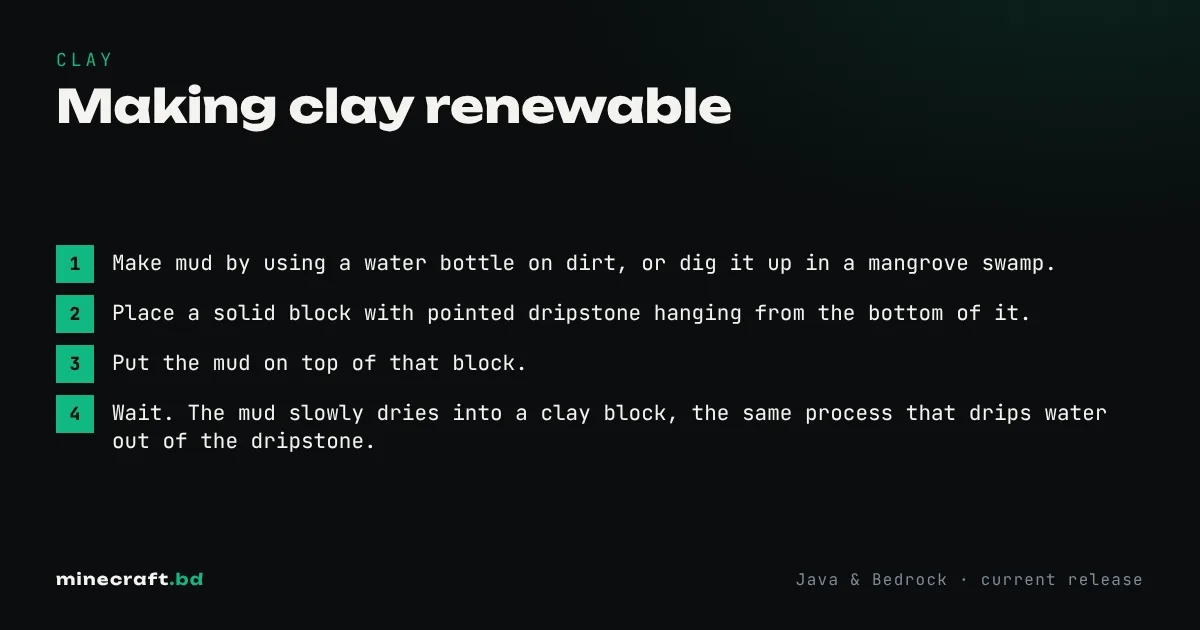
Since 1.19 you can turn mud into clay:
- Make mud by using a water bottle on dirt, or dig it up in a mangrove swamp.
- Place a solid block with pointed dripstone hanging from the bottom of it.
- Put the mud on top of that block.
- Wait. The mud slowly dries into a clay block, the same process that drips water out of the dripstone.
A row of these near your base gives you a steady trickle of clay with no diving. It’s slow, so build several if you need a lot.
Mason villagers who see you with the Hero of the Village effect after a raid will also throw you clay balls.
What clay is for
- Bricks. Smelt one clay ball to get one brick; four bricks make a brick block. See how to make bricks. Bricks also make flower pots and decorated pots.
- Terracotta. Craft 4 clay balls into a clay block, then smelt the block. It comes out as plain terracotta, which you can dye 16 colors and smelt again into glazed terracotta. How to make terracotta has the details.
- Emeralds. Novice masons buy 10 clay balls for 1 emerald, which is an easy way to level a mason up. Placing a stonecutter turns an unemployed villager into one; see all villager jobs.
If you just need terracotta in bulk, badlands biomes have whole hillsides of it already colored, which is quicker than digging clay.
Common questions
Where is clay most common?
On the floor of shallow rivers, lakes and swamps, in gray-blue patches, and around the water pools in lush caves. Mangrove swamps are also good because of all the mud nearby.
How many clay balls does a clay block drop?
Four, whatever tool you use. Fortune does not increase it. Silk Touch drops the clay block itself.
Can you make clay renewable?
Yes. Put a mud block on top of a block that has pointed dripstone hanging under it. After a while the mud dries into a clay block.
Sources & verification
Facts on this page are checked against these references and in-game behavior for the stated edition(s). how we verify.
Keep reading