How to Make a Name Tag in Minecraft (New 2026 Recipe)
Craft a name tag from paper and an iron, gold or copper nugget in Java 26.1 and Bedrock 26.10. Older versions, finding one as loot, and using it.
In current Minecraft you can craft a name tag from one piece of paper and one nugget (iron, gold or copper). That recipe arrived in 2026: Java 26.1 and Bedrock 26.10. If you’re playing an older version such as 1.21.x, name tags can’t be crafted, and you have to find them in chests, fish them up or buy them. Either way, a fresh name tag is blank: you give it a name on an anvil, then use it on a mob.
Crafting one (26.1 and newer)
You need:
- 1 paper, crafted from three sugar cane
- 1 nugget: iron, gold or copper. Put an ingot in the crafting grid to get nine nuggets, or smelt down old iron or gold tools and armor.
Put both in a crafting grid and take the name tag. It’s cheap enough that you can make one for every pet and farm animal you care about.
Finding or buying one
Crafting is the easy route now, but name tags still turn up as loot, and on 1.21.x and earlier these are the only ways to get one:
- Chests. Dungeon chests and mineshaft chests are the best bet. Ancient cities and woodland mansions also had them until the 2026 updates removed them.
- Fishing. Name tags are part of the treasure loot. Luck of the Sea raises your treasure odds, and our fishing guide covers setting up for it.
- Librarians. A master-level librarian could sell one for emeralds. In current versions librarians no longer stock them; a wandering trader may sell one for 1 emerald instead.
Renaming it on an anvil
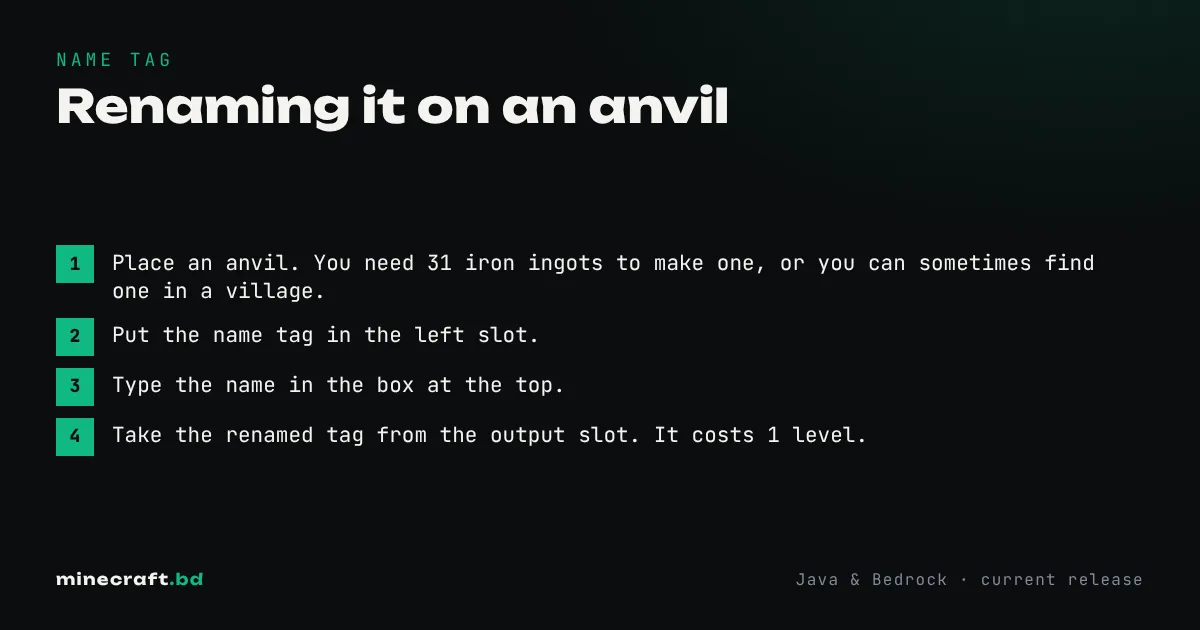
- Place an anvil. You need 31 iron ingots to make one, or you can sometimes find one in a village.
- Put the name tag in the left slot.
- Type the name in the box at the top.
- Take the renamed tag from the output slot. It costs 1 level.
You can rename a whole stack at once for that same level, which is handy if you’re naming a field of cows “Steak”.
Using it on a mob
Hold the named tag and use it on the mob (right-click on PC, the left trigger on most controllers, tap on mobile). The tag is used up and the name appears over the mob. You can rename the same mob later with another tag.
What naming does:
- Stops despawning. This is the main practical reason. A named zombie in an iron farm, a named villager in a trading hall, a named horse you’ve left in a field: none of them will vanish when you walk away.
- Keeps track of pets. Wolves, cats and horses all look alike after a while.
- Gets carried over. If you name a zombie villager and then cure it, the villager keeps the name.
Name tags only work on mobs. They can’t rename other players.
The special names
A few names do something extra. They’re case sensitive.
- Dinnerbone or Grumm flips any mob upside down.
- jeb_ on a sheep makes its wool cycle through every color. It still drops wool in its original color. If you want to set up a rainbow sheep pen, see how to breed sheep.
- Toast on a rabbit gives it a black-and-white memorial skin.
- Johnny on a vindicator makes it attack nearly every mob around it, not just players and villagers.
Common questions
Can you craft a name tag in Minecraft?
Yes, in current versions. Java 26.1 and Bedrock 26.10 added a recipe that uses one paper and one nugget (iron, gold or copper). In 1.21.x and earlier there was no recipe, and name tags had to be found or traded for.
Do named mobs despawn?
No. A mob with a name tag never despawns naturally. The exceptions are wandering traders, which leave anyway, and hostile mobs if you switch the difficulty to Peaceful.
What happens if you name a mob Dinnerbone?
It turns upside down. Naming a sheep jeb_ makes its wool cycle through every color, naming a rabbit Toast gives it a special skin, and naming a vindicator Johnny makes it attack almost every mob nearby.
How much XP does renaming cost?
One level on an anvil, and you can rename a whole stack of name tags at once for that one level if they get the same name.
Sources & verification
Facts on this page are checked against these references and in-game behavior for the stated edition(s). how we verify.
Keep reading